Set personal and shared goals
Work toward something of your own or choose a family goal, like hiking four local trails. Each goal starts with four planning checkpoints, and you can add a measurable target when it helps.
 For families with shared goals
Give everyone in the family a goal to work toward and a way to help. Pick a goal, break it into small steps, and make time to see how far you’ve come together.
Pairvoy for Family 0.1.4 · Public beta coming soon
Bring personal goals and shared plans into one workspace. Whether you’re working toward a family hike or starting a reading habit, everyone can see their next step and celebrate the progress they help make.
Work toward something of your own or choose a family goal, like hiking four local trails. Each goal starts with four planning checkpoints, and you can add a measurable target when it helps.
Create local profiles, assign dated actions, and see what’s due today. The calendar’s timeline and agenda bring upcoming goals and tasks into view.
See completed actions alongside progress toward the outcome. Review the week’s activity and write a short reflection on what worked and what to try next.
Earn XP, track streaks, unlock achievements, and set family experience rewards, like a movie night. Participation reflects each person’s own planned commitments for the week.
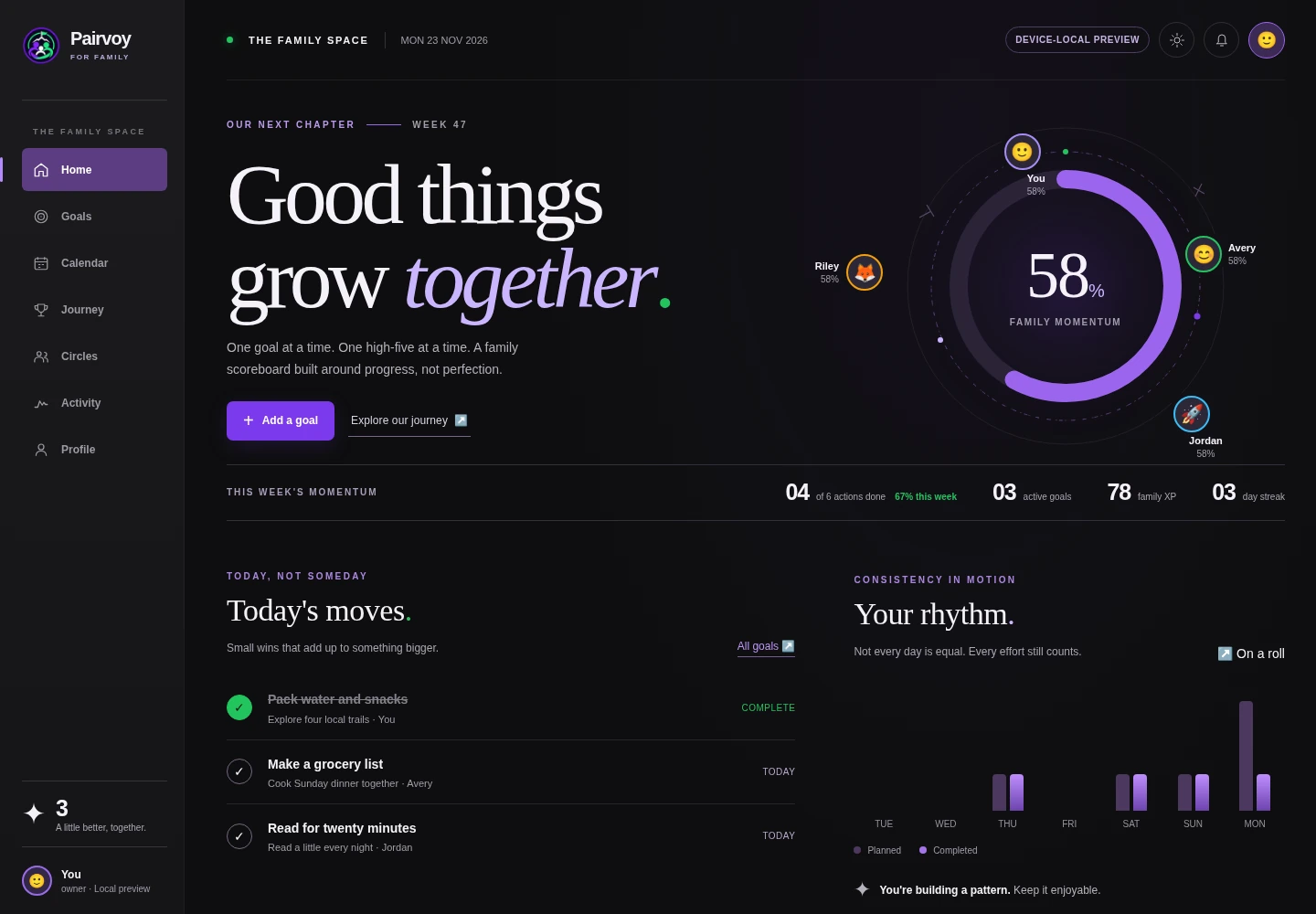
Pairvoy for Family uses the same ORBIT interface across its configured builds. A shared rules engine validates changes to goals, milestones, and profiles before saving them to the device.
| Dependency | Version | Role |
|---|---|---|
| Expo | ~57.0.27 | Development tooling and web and Android builds |
| React and React DOM | 19.2.3 | App components and browser rendering |
| React Native / Web | 0.86.3 / ^0.21.0 | Shared app shell and browser support |
| TypeScript | ~6.0.3 | Compile-time type checking |
| AsyncStorage | 2.2.0 | On-device workspace and preferences |
| React Native WebView | 13.16.1 | ORBIT rendering on Android |
| Electron / electron-builder | 45.0.0 / 26.18.0 | Windows runtime and installer packaging |
Build environment. The project declares Node.js 24 or 26. Its Node.js 24 quality workflow passed for 0.1.4, covering automated tests, TypeScript checks, the web export, and the npm audit step. Windows installer and Android device acceptance are separate checks.
Project facts. Pairvoy for Family is developed separately from Pairvoy for couples and has its own local data store. It supports nine goal categories, including Health, Learning, Home, and Finance. The source is maintained in a private repository with an MIT license file.
Goals, actions, and profiles live on the device. Use sample data during testing, especially for child profiles. Separate sign-ins, invitations, and cross-device sync are planned for a future release.
Version 0.1.4 adds editable profiles, avatar and photo options, persistent light and dark settings, and a choice of date-entry styles. Reminder preferences can be saved locally. Automatic notifications are planned for a future release.
Beta access details will be posted here when testing opens.
Explore the original Pairvoy for couples